
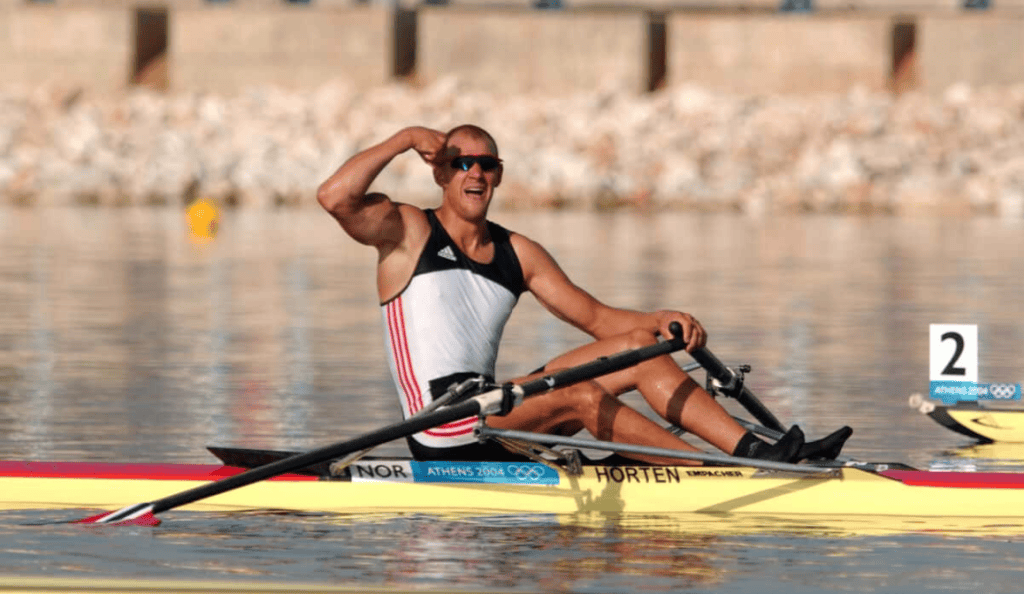
Olaf Tufte died on 21 July 2026, aged 50. His family shared the news, and it was reported by Reuters and NRK. Our thoughts are with his family, and with everyone in rowing who knew him.
I am not going to try to write his whole life here. I want to talk about the qualities I keep coming back to, from the conversation we had on Episode 35 of Mercantile Radio earlier this year, and from the way he raced.
When I welcomed him onto the show, I called him someone I have loved having conversations with over the years. He was generous and funny, and completely honest about what it takes to win and to keep coming back.
We first raced against each other back in 1996 in the coxless fours. After this Olaf went into the double sculls and then the single. I always loved our conversations. He was relentless in his pursuit of boat speed under pressure, and was always curious about how to improve.
Drew Ginn OAM
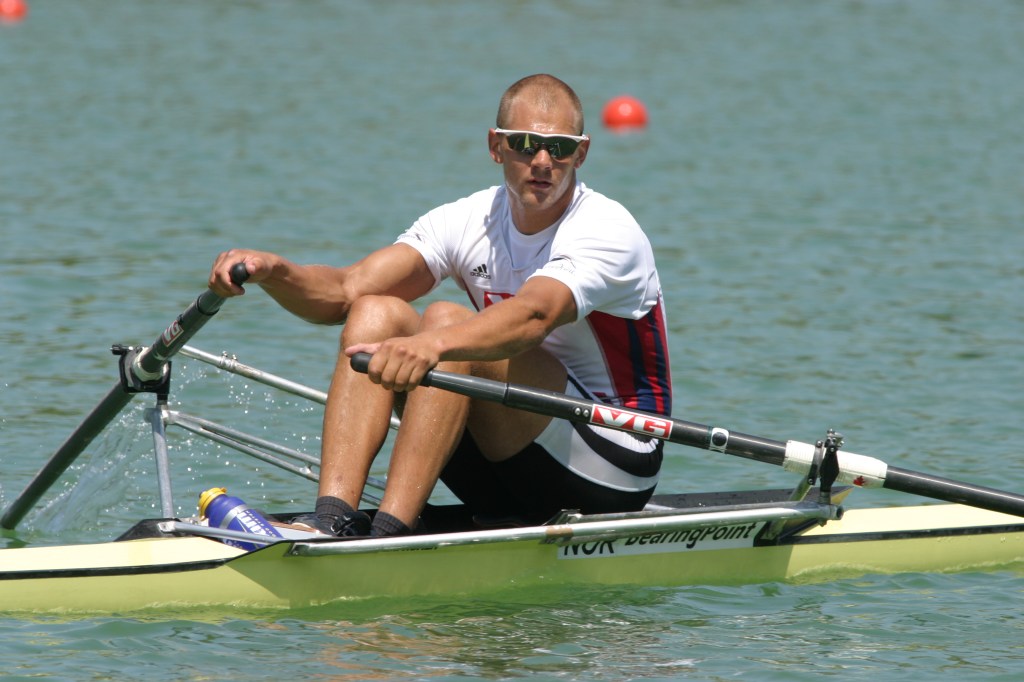
Photo: SybrandTreffers, CC BY-SA 4.0, via Wikimedia Commons
Stay in your lane
The first thing I asked him was about the Athens final in 2004, when he won his first Olympic gold in the single scull. I had just watched it again. Around the 1,000, Jüri Jaanson put the foot down, and I wanted to know what was going through Olaf’s mind.
He said Jaanson almost knocked him off his horse. The third 500 was supposed to be Olaf’s place, and suddenly no one was supposed to be on his speed, and someone was. For a few strokes he was furious. Then he came back to the plan.
Every rower has to learn this: stay in your lane. Trust your process.
What carried him home, he told me, was trust in the work he had already done. “Trust in what I was good at was the key. Otherwise I would have gone totally off.”
That is as good a description of racing well as I have heard. Not the flashy bit. The bit where you stay with what you know when the race starts asking you to panic.
Raise the average
Olaf came to rowing late, at about 16 or 17, after motocross and a childhood full of sport. Some junior rowers used to come to the family farm to ride, and he followed them to the club because he needed winter endurance. He was not supposed to be a rower. Then they needed a body in a boat, and within a few months he was racing.
The speed, he said, came from years of work on the farm before he ever touched an oar. Too young to be trusted with the chainsaw or the winch, he spent hours dragging timber out by hand.
When I was 17, I already had 10,000 hours in my body.
That work ethic never really left him. Going into Beijing in 2008, he and his coach knew the truth about his rowing: when he rowed well, he was more than fast enough. When he rowed poorly, the field left him behind. So the brief was not to invent something magical. It was to raise the floor.
Bring my 80 percent as close to my 100 percent as possible: make the average of my strokes as good as possible.
The night before the final, his mental coach came back to the hotel so they could rehearse his first stroke one more time. He told me that when he took that first stroke in Beijing, it felt exactly as they had pictured it. Talking about it all those years later still gave him goosebumps.
I raced at that same Beijing regatta, in the pair. Olaf won his second Olympic gold in the single that week.
I quit when I decide to
Longevity is easy to admire from a distance and hard to live. Olaf rowed at seven Olympic Games, from Atlanta 1996 to Tokyo 2020. He won silver in the double sculls at Sydney 2000 with Fredrik Bekken, gold in the single at Athens and again at Beijing, and bronze in the double at Rio 2016 with Kjetil Borch. He was twice world champion in the single, in 2001 and 2003, and collected six world championship medals in all. In 2021 he was awarded the Thomas Keller Medal, rowing’s highest individual honour.
The years after Beijing were not a straight line. There was illness, and a long stretch where his body would not do what it had done. He missed the A final in London in 2012. People wanted him to stop. His answer was simple.
No one was going to decide when I quit. I quit when I decide.
After London he sat ten people who had been around him for 25 years down at his kitchen table and asked them to be honest about what had to change: his rowing style, his training, his surroundings. They were. He listened, rebuilt, and in 2015, at 39, finished fourth in the single at the World Championships in Aiguebelette. It was enough to put him back on an Olympic start line.
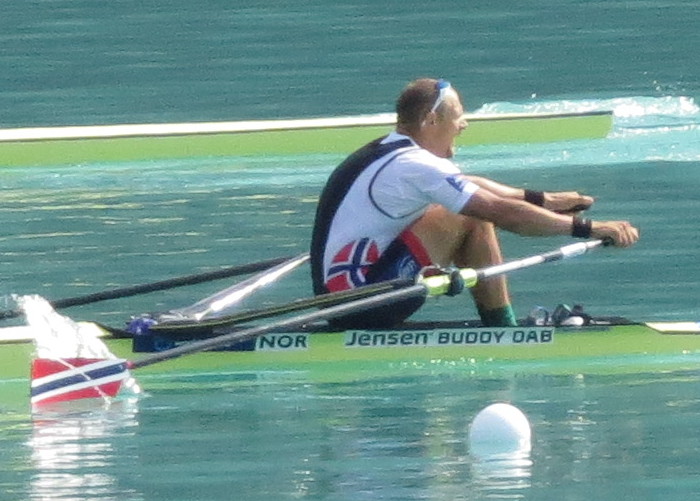
Photo: Shev123, CC0, via Wikimedia Commons
The moment he kept, though, was not the placing. It was passing the grandstands after he had made the final.
Everyone was shouting my name: competitors’ families, coaches, boat builders. Not because I had won anything, but because I never gave up and had come back. For me, that is one of the biggest victories in my rowing history.
A year later he won that Olympic bronze in Rio. James Tomkins, on Episode 3, said something that has stayed with me: “We looked up to Olaf. He was huge.”
He loved it
I asked him what it was like to last so long at the top. His answer is the one I will be passing on to crews at Mercantile.
I loved rowing. I loved being on the team, going on the water, performing and seeing if I could be better.
That is the quality underneath the others. The farm work, the trust in the process, the refusal to let someone else write the ending: they only hold if you actually love the work. Olaf did. Stay in your lane. Raise the average. And do not let anyone else decide when you are finished.
Have a listen to the whole conversation. There is a lot more in it, including how he thought about altitude, recovery, and playing in the boat.
Listen to Episode 35: Stay in Your Lane: How Olaf Tufte Built Two Olympic Golds
Spotify: https://open.spotify.com/episode/5oJj5VXrhpRSdIJwwbMMwi
Apple Podcasts: https://podcasts.apple.com/au/podcast/stay-in-your-lane-how-olaf-tufte-built-two-olympic/id1855369498?i=1000768307619


Leave a Reply