
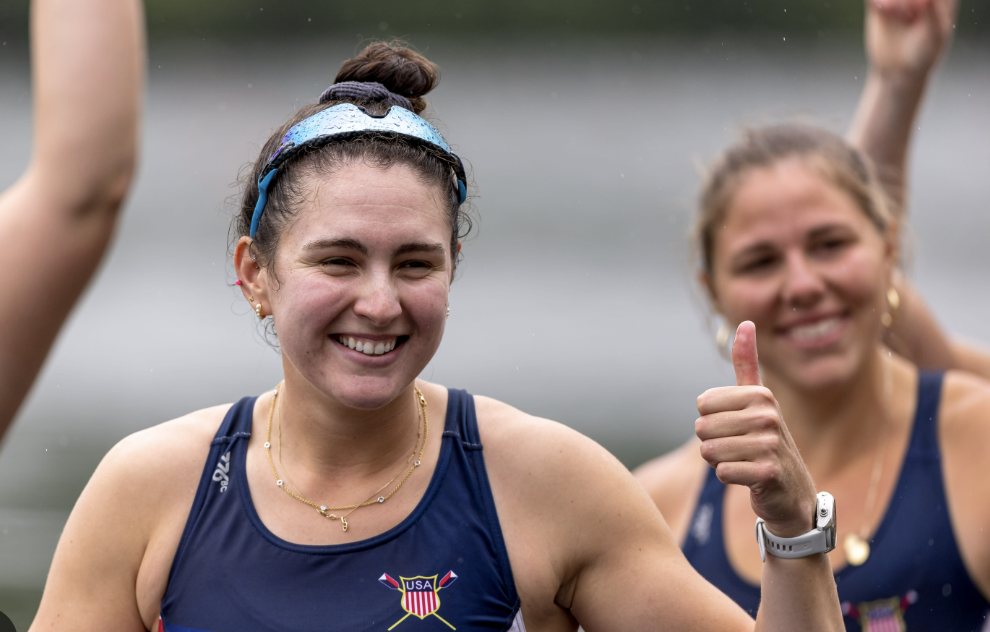
Some of the best coaching I’ve ever heard about happened in a phone call that lasted a few minutes.
It was 2023, the Olympic qualification year. Teal Cohen was in her first full year out of the University of Washington. She’d been injured, her body wasn’t responding to the training, and she got cut from the US team. “I was so down on myself,” she told me on Episode 46.
Photo: Mercantile Radio
The next day her coach from Washington, Yaz, rang. Teal was in a horrible mood and, by her own admission, ready for a good whinge. What she got instead was this:
“Okay, here’s the deal. You have nine months until Olympic selection. That’s plenty of time. This is what you need to do.”
“For a second I was like, oh, I just wanted to complain. How annoying,” Teal laughed. “And then I hung up and I was like, oh my God. You’re right. There’s plenty of time.”
The honest diagnosis
What I loved about Teal’s story is how clearly she saw the gap once the shock wore off. Coming out of college she’d thought of herself as a great boat mover, especially in small boats. That was true, but it didn’t matter. “You don’t get those opportunities unless your ergs are good enough,” she said. Her scores were fast for college but not for the national team.
So she spent that summer and autumn lifting, and doing a lot of erging, mostly at low intensity, which she’d never done much of before. Her attitude was simple: “I have to make the most of every single day, so I’m not gonna let a day go to waste.”
By the erg test around November or December she’d taken eight seconds off her 2k. “Once I saw those results I was like, oh, I have everything that it takes,” she said. “I just need to use it correctly.”
There was another line that stuck with her, from one of her Washington coaches before she graduated. Teal isn’t the tallest in the squad, and she was told:
“There are the small people who they put with the big ergs who aren’t great at rowing. You need to be the small person who’s also good at rowing and also really strong.”
Where those nine months led
Teal made the team and rowed the quad at the Paris Olympics. It didn’t go the way she wanted. She walked away feeling she hadn’t shown her best, and she told me that disappointment reignited how far she wanted to go. She moved back to the sweep squad and found herself in a four with three women carrying the same unfinished business. In 2025 they were world champions.
When I hear a story like Teal’s, I think about my own erg numbers. When I first made the team in 1996 I pulled 6:05 at 86 kilos. By the end of my career, at 37, I was 5:52 at about 88 kilos. None of that came in one season. Teal summed it up perfectly: “The easiest way to get faster is to do whatever you’re doing consistently. Consistency beats anything else at the end of the day.”
What makes that phone call great coaching is that it was belief delivered as a hard truth. Teal put it this way: a coach pushes you “because they believe you can be the best”. There’s no sympathy and no softening, just a timeline and a plan from someone who knew she could do it.
A Mercantile connection
This one started at home. Zara Peele, daughter of our club president Gina, was the one who said I had to get Teal on Mercantile Radio. Teal said something every young rower on our pathway should hear: “With success comes so many losses. You only see the successful parts.” Cut, injured or not fast enough yet, nine months can be plenty of time.
Listen to Episode 46: Eight Seconds and Nine Months, with Teal Cohen
Spotify: https://open.spotify.com/episode/2UAVpwrCCieKzMCratJyX6
Apple Podcasts: https://podcasts.apple.com/au/podcast/eight-seconds-and-nine-months-teal-cohen-on-getting/id1855369498?i=1000778461553


Leave a Reply