
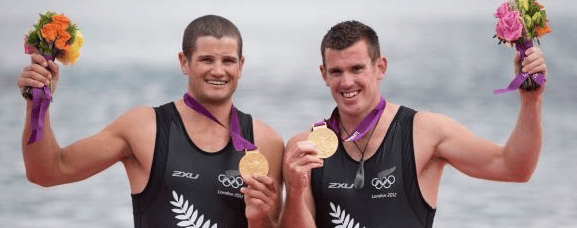
Joseph Sullivan crossed the line in the London 2012 Olympic final thinking he’d won a bronze medal.
He and Nathan Cohen had been sitting fourth in the men’s double. With 500 metres to go they went after the three crews ahead of them. Joseph told me on Episode 59 that he doesn’t remember seeing another boat. He was only looking for the finish line.
“I remember finishing and just being so stoked that we’d just got third.”
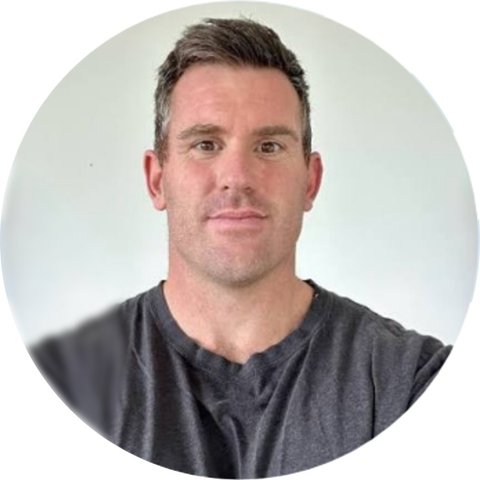
Photo: Mercantile Radio
Then he looked up at the big screen and realised they’d won. It’s one of the great finishes in Olympic rowing, and I’ve watched it more times than I can count. I wanted to know where that last 500 came from.
Rehearsing the finish
Everyone knew about their sprint, Joseph said. It wasn’t a secret. They’d always had to do it because of their size, and other crews were going to try to build a buffer early. The answer was in their training. Some sessions were nothing but 500-metre pieces, 12 to 18 of them, and they learned that however tired they were, they could always hit a certain time:
“Once we hit that final 500, no matter how cooked we were, we could just do a certain time.”
So when they got to 500 to go in London, there was nothing left to think about:
“We’re not going to die. Just give it everything. And we kind of just went full red line, went into the dark.”
They’d also spent the last 2K of every row inventing worst-case scenarios and working out how they’d deal with them. By the Olympic final, staying calm was normal. Nathan called the race and kept Joseph positive. Looking at the video later, Joseph reckons they weren’t as close as Nathan told him. He appreciated the trust.
A Jack Russell and a Labrador
They were very different athletes. Nathan was the consistent one, a numbers man and a workhorse through the middle of the race. Joseph was strong at the start and the finish, and much less consistent in training. Early on they argued about rate. Nathan wanted 36. Joseph naturally went higher, and at 36 he felt flat. Eventually, racing at Lucerne in what Joseph remembers as their first year together, Nathan went with Joseph’s rhythm instead of fighting it. Joseph recalls them finishing second.
“I’ve got short little legs and short little arms, so I’m exactly what a rower shouldn’t be.”
Joseph laughed that people compared them to “a Jack Russell racing a Labrador”. The lesson he took from it is one I come back to whenever I think about pairs and doubles: “You have to do what’s best for each individual to make a team work, I think.” They stopped trying to be the same, because “to play on each other’s strengths was a way better thing than to fight each other and make us the same.”
Too small, from day one
Joseph started rowing in Picton, at the top of New Zealand’s South Island, after winning the school cross-country. He was told to go down to the rowing club. On his first day the coach took one look at him:
“He’s like, you’ll be no good. You’re too bloody small.”
He heard versions of that for most of his career. He went to four New Zealand junior trials and was never selected. He went to the 2007 World Under-23 Championships as a reserve, won the single sculls in Glasgow, was told it was a fluke, then won it again in Brandenburg in 2008. In 2009 he added a third under-23 world title, in the double with Robbie Manson. His explanation is simple: “I’ve always been a racer. I’ve never been a trainer.”
That reminded me of something Mike McKay used to say when I joined the Awesome Foursome: we’ve got one or two big efforts in us a year. Joseph was the same. He saved it for the races that counted. He even made a habit of finding the camera on the start line, because his parents could rarely travel to watch him race:
“if I could find the camera and I could see it looking at me, I’d try to smile at it.”
After the gold
What came after London was harder. Joseph was told he could have four months off and build towards the next Olympics over four years. Within a month he was told to be back in the boat. He came back too early and was mentally burnt out, and after a difficult selection period he decided to leave on his own terms. He’s careful not to dwell on blame, and he thinks the system has learned a lot since then. But his point about athletes needing proper breaks is a fair one:
“I needed that mental break from rowing. I’d rowed 12 years straight.”
He spoke openly about a dark year after he stopped. Then a group of Hamilton firefighters who had driven athletes around during an event reached out and suggested he give it a go. He joined Fire and Emergency and found a crew again:
“the fire service is like being in a rowing shed. Like it’s just constant banter.”
These days Joseph is a firefighter, a dad and a coach of young coastal rowers, and he still has the same attitude to pain he had in London: “my thought was always it hurts now, but if I finish it faster, then it’ll hurt less when I’m done.” I know a few Mercantile crews who could use that line at 500 to go.
Listen to Episode 59: The Greatest Finish: Joseph Sullivan’s London 2012 Olympic Rowing Gold
Spotify: https://open.spotify.com/episode/5tNKWuVDJKRQyVDHUqeZR2
Apple Podcasts: https://podcasts.apple.com/au/podcast/the-greatest-finish-joseph-sullivans-london-2012/id1855369498?i=1000796974866
Read the full episode notes: Episode 59: The Greatest Finish: Joseph Sullivan’s London 2012 Olympic Rowing Gold


Leave a Reply