
We recorded this one standing in the boat park at the Head of the Charles, on a Friday afternoon, with crews going past and sessions still to come. Paul Cooke has been coming to this regatta for a long time.
“I raced here in 1986 for the first time,” he said.
What has stayed with me is not the costumes, or even the titles that followed. It is a sentence he still remembers from Steve Gladstone, and what he did with it.
“I’ve got to either step up to the plate here and figure this out … or give someone else a chance.”
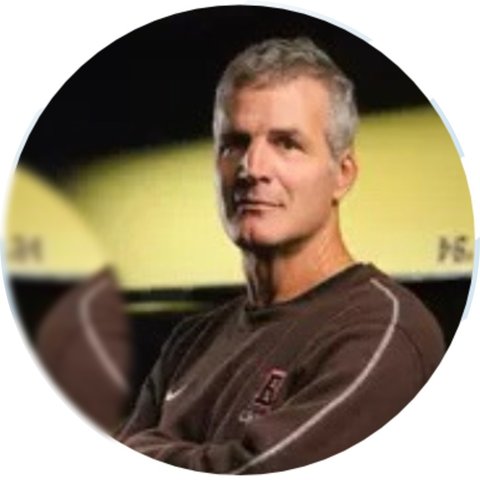
Photo: Mercantile Radio
A shock of advice
He started coaching the lightweights at Cornell, then worked at Brown after Gladstone left, first under Scott Roop, and later as head coach. The job came with a history. “Brown had done really well, especially under Steve,” he said, “and we’d had lots of guys go on to the Olympics.”
I asked if that was intimidating. “Yeah. And the first couple of years took … me a little while, frankly, to get on my feet.” He had had pretty good success as an athlete. Then he ran into seasons where, as he put it, “I’m really not doing this as well as I would like to.”
The conversation with Gladstone was the turning point. “If you’re not going to be able to do it, give someone else a chance,” Paul remembers him saying. “It was a bit of a shock to be confronted … I’ve got to either step up to the plate here and figure this out … or give someone else a chance. And that was very motivating, clarifying and difficult.”
He started reading, and found the sports psychologist Bill Beswick. The book was about soccer, Paul said, but it was really about the head game. He began asking his athletes: “What would Steve Redgrave do in this situation?”
He also built a staff he could trust. “You trust amongst the coaches to really have each other’s back,” he said. “It was huge.”
The proof, for him, came in 2006, when Brown beat Harvard. “They hadn’t lost a race for 32 races,” Paul said. “That was like, wow … I can actually do this job.”
“I’ve been blessed by having a fair amount of resilience and curiosity,” he said. They have won the Easterns and the Ivy Championships a number of times. What he values is being able to take a crew as it is — sometimes in good shape, sometimes with a lot of work to do — and find a way through the campaign. At 58, he has also learned that “you don’t have quite as much control as you would think, and you just have to kind of trust” and “do the things that you could do.”
What’s the difference?
That curiosity is what I keep coming back to. He remembers watching the great Brown crews of the 1990s warming up, not long after Gladstone left: Jamie Koven, Xeno Müller, Igor Boraska and that group. About ten years later, coaching his own team, he looked around and thought, “these guys don’t look the same. So what’s the difference?”
So he got analytical. Did they look as physical? Did they need more time in the weight room, or more running?
He gives his athletes the same challenge. “You’ve got to be honest with yourself,” he said. Look at the athletes ahead of you, find one you can relate to, and work out “what’s he doing that I’m not doing?”
On recruiting, he loves the global mix in American college rowing now, which he called “sort of like the Premier League for soccer.” The traits he looks for are simpler. “We look for people that just love the sport,” he said. “If you love the sport, you’re going to love the training. You’re going to love the people.” He wants physical courage, people who like to push themselves, and people who see the team as bigger than themselves.
He is proud of what Brown has contributed to United States rowing. In his telling, more US athletes from Brown have probably made the IRA grand final over the last twenty years than from any other program, and some of those people have gone on to World Championships and Olympic Games. He was excited that Gus Rodriguez had just won the men’s four at the World Championships.
The first foot
When I asked him what actually makes an eight go, he did not start with a long list of drills. “Getting the momentum of the boat and of the drive right is probably like the most important thing … that can be done,” he said. Without it, “it’s like having a 15 horsepower engine” up against something far bigger.
If the momentum of the drive is right, he said, you tend not to hammer the catch. You try to pick the boat up at the speed of the run. “You can only really match the momentum.”
He recalled a remark of James Tomkins. “If you missed the first foot, you don’t get it back.” The skill is to get the blade in without disturbing the hull, then load it quickly, and accelerate from there. You will never be perfect at it. You can get close. And when the feeling is right, he said, that is the magic of being in a good eight.
When the train leaves the station
I asked him what he was most proud of, expecting a list of trophies. Instead he said: “The most important moments for me are the ones where it’s kind of like the team got on the train and left the station, and you’re kind of left there back just watching.”
There is not that much to do then except observe, and feel that they have figured some things out. One of those times was the 2009 Sprints sweep. “I was the least ready,” he said. The athletes had it almost sorted. The coach was the one wondering whether they could pull it off. “I don’t know if we could do that.”
He is still very much part of the team. He does the gym session with them, twice a week at 7.30 in the morning, because it keeps him in touch with the work and makes him feel as if he is on the team. He often works on lineups right up to the 30-minute deadline before practice, and does a lot of his thinking while walking or running.
When he was starting out at Cornell, the heavyweight coach there, Finn, had been badly affected by a stroke and could no longer coach. He started coming out anyway, and Paul treasured those conversations. What a coach often needs, he said, is someone willing to offer something, without needing to be in the middle of it.
What I take from Paul
I have met plenty of coaches who can talk about winning. Not many will tell you about the seasons when they were not doing the job as well as they wanted, or about the mentor who said so to their face. Paul heard “give someone else a chance”, took it on the chin, and has spent the years since looking for the difference, trusting his staff, and noticing the days when the crew no longer needs him.
To our Mercantile coaches, the lesson is simple. Stay curious. Be honest about where the crew actually is. And judge yourself, at least sometimes, by how well the boat runs when you are left on the platform, watching it go.
Listen to Episode 61: Step Up or Step Aside: Paul Cooke on Coaching Champions | Brown University Rowing
Spotify: https://open.spotify.com/episode/4Us8Lo2S7TmE9Azajb1CSm
Apple Podcasts: https://podcasts.apple.com/au/podcast/step-up-or-step-aside-paul-cooke-on-coaching-champions/id1855369498?i=1000799280607
Episode page: https://mercantileradio.au/2026/11/02/step-up-or-step-aside-paul-cooke-on-coaching-champions-brown-university-rowing/


Leave a Reply