
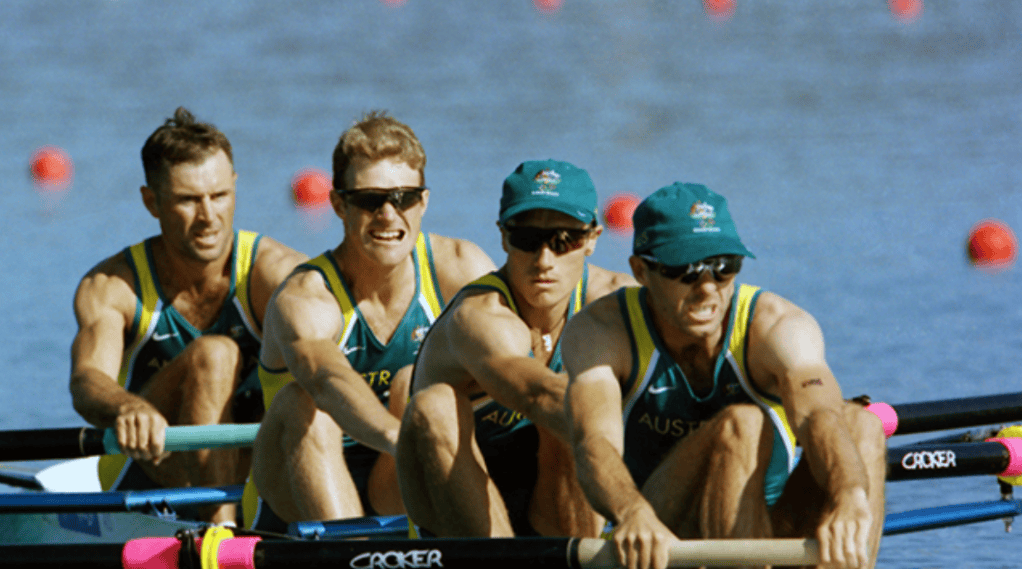
Ken had already started the film when I got there. I had been sitting at home, a little bit panicked, because I had forgotten about the session. Eddie had texted me. On the way over I opened an old clip of the Oarsome Foursome in 1992, race work in Varese, the video Noel Donaldson had given me years earlier.
Never perfect
What I noticed, watching it again, was that it was not perfect. And when I stood at the back of the room and Ken highlighted the blades — some pushing the water, some up, some down — I had just seen the same thing in that old four.
“Appreciate that it’s never perfect,” I told the coaches in the room. You can spot the little things, and that attention to detail matters. The question I wanted to sit with, though, was how you bring a crew together, and how you let go of some of those nuances long enough to do it. How do you bring a four together, or an eight, or a pair, once you have seen all the little imperfections?
Anthony Edwards was with me for the afternoon. The principles, I said, are the same, whether you have been to an Olympic Games or you are in a club four. “Our experiences are very very similar to your experiences.” The technical work is assumed. What we wanted to talk about was the other half: the people, and how they actually come together.
It starts with the coaches
I keep coming back to 1996. The year before had been a disastrous one, and there was a lot of pressure on the team. What changed, as I saw it, was that five key coaches came together and described what they wanted success to look like, and how they were going to work with each other. They were still competitive people. But the crews involved with those five coaches connected better, and worked off each other better.
If they had not had that honest conversation about what they wanted Atlanta to be, I do not think it would have found its way out to the crews. Eddie was on that team. I was in the four. We felt like a unified unit, even though nobody sat us down for a big all-in session about who we all were.
A boat club is not so different. It can start with one or two people having a conversation, and then you keep bringing people in under the umbrella.
Fourth in the heat
Anthony’s story from inside a crew is the one I have been thinking about since. It was the lightweight four for the 2010 World Championships, at Lake Karapiro in New Zealand. A long campaign. They had come together in April, raced abroad, then trained in Tasmania, including a block in the Huon Valley, four quite individual athletes.
Anthony had already been to four Olympic Games. Sam, he thought, had been to two. Blair had not been to an Olympic Games yet, but he was coming through. Different personalities: a hothead, a real driver; someone with a never-say-die attitude; and then this other athlete, physically exceptional.
“His name’s Blair,” Anthony said, “and some of the Tassie coaches will probably know who I’m talking about here, but that’s okay.” Blair Tunevitsch was, in Anthony’s words, one of the strongest, most powerful athletes he had ever rowed with. He thought he had produced a 6:08 for a 2k erg, as a lightweight. “When he’s on, unstoppable. But he can have a bad day, and he can have a really bad day.”
The first week, they could not get the blades off the water. School crews, junior crews, would have been beating them. They would stop, roll it in pairs, combine again, and maybe find half a dozen good strokes, or 500 metres of good stuff, at the end. Then they would come back the next day and start badly all over again.
It got completely frustrating, coach included, and Anthony could feel it all starting to push back onto Blair. Sam wanted to win at all costs and was not going to pause. Skippy — Todd Skipworth — was just going to keep driving. The coach was busy looking after the program. So Anthony took Blair on.
A cup of tea, and a supermarket
He did not start by fixing the rowing. He tried to get to know him. Sometimes they would grab a cuppa and talk about family, or the last holiday, and not talk about the boat at all. When they went overseas, the other two would hand Anthony the keys. “You’re with Blair.”
He roomed with him everywhere. After training, Blair would go straight to the shower, put his skins on, get on the bed, music on, mental imagery, twenty minutes, and that was that. At the supermarket, Anthony said, most of us go in for five items and come out with fifteen. Blair went in for three items and came out with three.
“This guy is just very straight down the line.” Once Anthony started to see that, the frustrations in the boat made more sense. They became mates. They still are. And when he came back to the crew, he could see what was going on, and work with it, instead of just pushing back.
At Karapiro they came fourth in the heat. It was not looking good. They talked it through, went through the repechage, and made the semi-finals as the twelfth-lowest of the boats that had got there. In the semi, with 200 metres to go, they were sitting fourth. Anthony looked across at the Swiss, who were in third, and yelled as loud as he could.
“How much do you want?”
It was painful, he said, and rough, and rugged, but they pushed twenty strokes and got through, “by that much.” They had made a World Championship final after coming fourth in the heat. Watching that third 500, he said, is still one of the most satisfying moments of his rowing career, because of the team element he had brought to it. They went on to take silver, in a finish that was as tight as anything I know.
What I take from Anthony
I have sat in plenty of boats where one person is hard to read, and the easy thing is to decide that they are the problem. Anthony did the slower thing. He made space for Blair to be who he had to be, long before the moment in the last 200 metres when the crew needed him.
To our Mercantile athletes, and to the people coaching them: get to know the person before you try to fix the stroke. And when the race is on, do not be afraid of a simple question.


Leave a Reply