
I spent an afternoon with Decent Rowing talking about sweep technique, and I did not start with a long list of drills. I started with the way I actually think about the work.
“My simple way of thinking about rowing is get the sequence right, get the length right, get the power right, and then really play around with rhythm and pacing.”
That order still matters to me. If the first pieces are not there, I do not think you should be in a hurry to dress the stroke up.
“If you haven’t got that bit right, don’t progress.”
A simple order
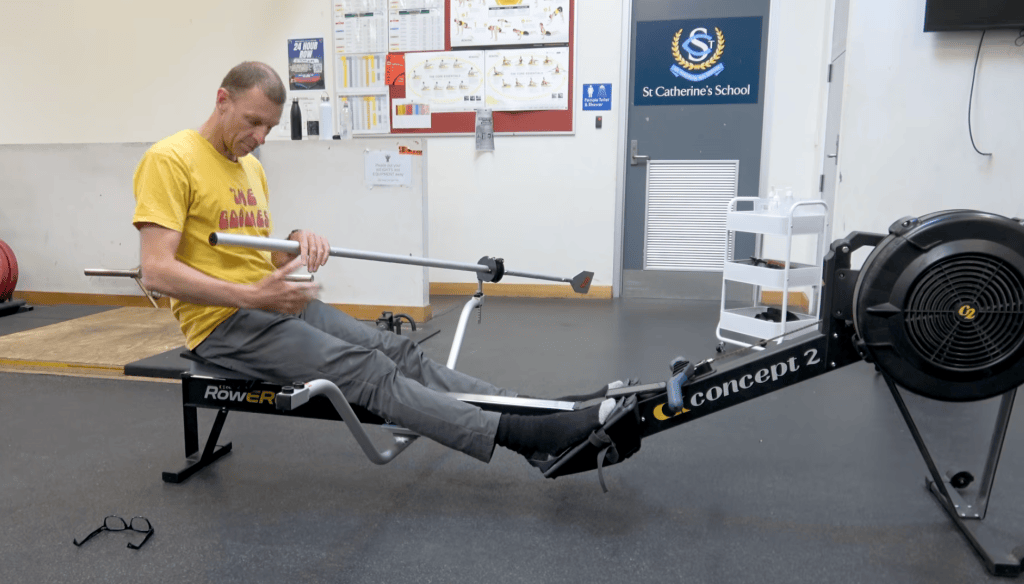
A lot of rowing starts at the finish. Feet planted, legs planted, a strong base. From there I like the idea of sequencing the arms first, and feeling the outside hand lead us away, into the hip stretch. “Even as a 50-year-old with a bad back,” I said, “even the ability to just lengthen and let that lead me out into that sort of movement.”
What you get, without being mechanical, is arms away, body over, and then the slide. Those basics have to be in place. The length comes next. I loved, way back in 1996, rowing with the four, how much we talked about how long you could row in the boat, “almost as if we were turning ourselves inside out.” That was not a poetic extra. It was the work. If you can get the bookends of the stroke right — the finish, and the length in front — then you have somewhere to put the power.
The finish I think about is a long position with no tension in the upper body, then the move out to a place where the shins are just over vertical, particularly when you are paddling. Shoulders down. Shoulders loose. Only then do I start to think about putting power on.
Power, without grabbing it
In small boats especially, when the hull is moving around, people tend to bring too much tension. In an eight you can get away with sitting a bit more upright. In a pair, having spent a lot of time there, I am thinking about sequence and length the whole time, then getting the power on — but with relaxation.
The typical thing, if you are holding an erg chain or an oar, is to grab and load. My biggest thought at the catch is to keep that handle out there as long as possible, and as well connected as possible. That is the elasticity. You do not want to grab the tension with the shoulders.
Noel Donaldson used to have a phrase for the way you sit. “It’s almost like sitting back in the armchair.” You do not want to go so far that you are no longer stabilising the boat. But if you can sit still, onto the inside of the rigger in a sweep boat, with the shoulders down and no tension in the sequence, you have a place to start from.
In a pair, if I am committed to my rigger, and my partner is committed to theirs — Duncan Free, or James Tomkins, or Mike McKay — you get a platform. It will feel unstable if you mistime it. The work is still into the rigger, and out of it, together.
The outside hand, and a blade that stays flat
I keep coming back to the outside hand. It leads us away. When I think about grip, it is still in charge of the handle, but it is the middle of the hand that is leading the movement, not a clenched, high-elbow idea of strength.
On blade depth I am a bit biased. “I was taught early in my rowing career was to be flat. That’s important, no doubt. Top edge just under.” Over 16-odd years internationally I came to realise that blade depth makes more difference than we usually understand, and maybe not in the way we conventionally think about it. Pin height and gate height determine a lot of where you can carry the handle. The early days with the four, in 1996, taught me a lot of that.
Feet-out work is part of the same idea, on the water and on the erg. In 2012, in the London four, we did a lot of it. For me the point is the sense of pressing and holding the weight through, and being able to push from the foot stretcher, so that the blade can go through the release as far as it can. If you get under it with the feet out, you get caught. That is useful information.
Breathe
Rhythm, for me, is not a separate trick you add at the end. It is what you can play with once the sequence, the length and the power are there, and once you are actually moving with the boat. On a stationary erg it can feel a bit surreal. The body can stay still at the finish while you change speed. On the water, the question is how far you can get the boat to travel every recovery.
When we talk about relaxation, I would rather talk about breathing. Belly breathing: letting the diaphragm and the pelvic floor do their jobs. At the finish I like to know where I am breathing in the stroke. I try to breathe twice on the recovery, to keep the movement relaxed, and then exhale as I clamp onto the handle.
“Having had back injuries and back surgeries probably meant that I wasn’t the smartest learner at the start of my career but eventually worked this stuff out later on.” Breathing and relaxation are critical, especially if you are coaching young people, and so is how and where you produce power. A simple call is just to breathe. Breathe out, let me hear it. Breathe in, deep breaths. Then look at whether it is going into the belly or into the chest.
If you cannot produce that on the water, practise it sitting on a stool. It is not a fancy drill. It is a way of getting the body organised before you ask it for more.
What I keep coming back to
I closed that session with a picture that is almost too simple. Rowing is like starting a chainsaw and then chopping down trees, over and over again, a couple of hundred times. “You’re working out pretty quickly if you’re chopping down trees the wrong way.”
That is the whole point of the order. Sequence, then length, then power, then rhythm. Not because I want everyone to row like me, and not because this is a syllabus to work through by Friday. Because if you skip the first things, you can spend a long time looking busy, and still be chopping the wrong way.
To our Mercantile athletes: start with the simple things, and stay relaxed enough to feel them. The boat will tell you the rest.


Leave a Reply