
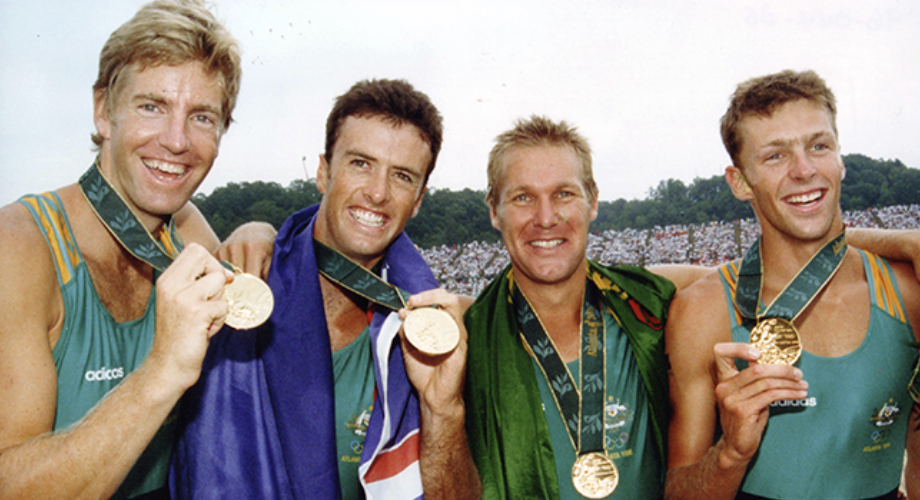
The same Decent Rowing afternoon, later on, I found myself talking about the crew I joined when I was still a kid, and about a taper we once invented because a later four had stopped believing in itself.
Anthony had just told the room about Blair, and about making space for someone who did not fit the easy version of a teammate. I said I thought everyone in a boat has had one of those people. In the Oarsome Foursome, that person was Mike McKay.
Average age, and a coffee table in Footscray
The Oarsome Foursome had looked towards lightweight rowing. Here were smaller, lighter, more nimble athletes doing extraordinary things with their boat, and that was a point of inspiration. We used to look towards those crews, and they would often look towards ours.
Inside our own boat, the differences were the point. “Drew and Mike can’t be together too much,” I told the room, “because we were intense, and we would get fiery.” We even rowed in a pair together, and that pair was volatile. Noel Donaldson would spend a ridiculous amount of time with Mike after training, until you finally had to stop the conversation.
Mike was physically the strongest, and he was rough, and even he would describe it that way. James and Nick did not want to row like that all the time. It would have been easy to decide that everyone should think the same. What I have kept seeing is the opposite. “It’s the differences … that you bring together. And when you bring difference together it actually takes time.”
I first joined them late in 1995. I was 20. They were 27, 29 and 30. “I got told the benefit I brought to the crew was I brought their average age down.”
What I was fascinated by, as a new athlete, was that I was given a voice. We sat in Mike’s house in Footscray and had a conversation about what success would look like in 12 months’ time. “As a brand new young member, I got a voice. And that gave me confidence.” Mike was driving the process, because he was the most competitive in the group. In the meeting he would go, no, it’s like this. James would say, maybe it’s got to be a bit smoother. Nick would sit there and say it would be all right, it would be fine. The same tensions around the coffee table were the same tensions out in the boat.
Mike said success was gold, and nothing else. James said he wanted to row really well, and to focus on the process. The coach sat in the middle of it. What they allowed, for me as a young kid, was space to be included. In our crew, Nick Green often roomed with Mike overseas, because he was the most laid back and could deal with it. Before Atlanta, we decided Mike would get his own room.
Even the start line was a personality test. Nick and I would get stressed sitting there. We would have preferred to arrive just before the two-minute time. Mike wanted to be there almost half an hour before.
A race plan you can say out loud
One of the things I think you can give any crew is a really clear race plan, kept really simple. The Oarsome Foursome’s plan was like that: stride and breathe at 250 metres, the catches at 500, swing at 750, legs at the thousand, sit tall and push with 1,250 to go. With 500 metres to go you are sitting tall, breathing, and getting ready to launch again with the hips. With 250 to go you are trying to lean on it and move the hands.
I could repeat it, train it, and teach it. I was calling it from the bow, and Mike, in the stroke seat, needed to hear the markers clearly. The feedback was simple. “If you’re not loud enough, Drew, we don’t hear you.”
The race plan never changed. It was the same plan as in 1992, and the same one we used in 2012, and the same calls Duncan Free and I used all the way through. James even steered from the two-seat. We had worked out what was best for us.
The intensity was still there. In the 1996 semi-final we came third. We had qualified, but we had not won, and we had been in a winning position. In the room afterwards it was, “It’s your fault. It’s your fault. No, it’s your fault.”
The Super Taper
Those same principles had to be rebuilt for a new Olympic crew. In 2012, with Josh Dunkley-Smith, I did whatever I could to match up and make him feel comfortable, even things you would never teach as textbook technique. James Chapman, sitting behind me, was 32, and had been a reserve for years. Will Lockwood was 24. The whole thing was about giving everyone belief and confidence.
The year before, in 2011, it had not felt like that. My mindset, and Chris O’Brien’s, was that this is not working, what have we got to fix. Samuel Loch and Nicholas Purnell were in that four with us. “We kept trying to attack … and trying to work out what to improve, and it just got worse and worse and worse.”
So we came up with something we called the Super Taper. We shared it with the guys before we went to Bled. We have done all the work, fellas. Twenty days out we start to freshen up. Ten days out we do this. The heat is going to feel rough. The semi-final might feel a little better. The final is when we will see our best.
Two years later, Josh said to me that the Super Taper had been amazing. “I said, mate, that was a joke.” We had done what it took to give the crew confidence and belief. Samuel and Nicholas had believed the Super Taper was legit. Chris and I laughed about it afterwards. In 2011 and 2012 we were two different crews, slightly better racing standards the second year, and when I compare it to the Oarsome Foursome, it was all the same principles.
Tomorrow morning
I started late. I was 17, and it was a maths teacher who got me into a boat. “If it hadn’t been for someone who cared, who saw something in a student in a classroom … it was Bram McLeod who actually took me down and put me in the boat.” I was not the best rower in the school. That was obvious. But I was encouraged to have another go, at the club, at the state crew. I had lost my mum when I was 11. I had done a lot of other competitive sport. I did not arrive with a vision of being an Olympic rower.
The other thing I have kept is a slightly unusual sense of optimism. I used to love it when Noel would say, “Tomorrow morning we just start again.” You have had a crap day. That is okay. Tomorrow morning we start again. Go back to basics. You can always reset. You are not defined by yesterday.
If you think the medal is what the sport is all about, I said, you are kidding yourself. I was very lucky to be part of the Oarsome Foursome. I know that, and I am humbled by it. What I liked was that Noel talked long term with me early on, not long-term success so much as loving the sport. The lights go off, no one is in the club, and you still have to do the erg. If you can be encouraged to love that part, you have a chance of lasting.
What I keep coming back to
Make space for the person who does not fit the easy version of the crew. Keep the plan simple enough to say out loud. And when it has been a crap day, start again in the morning.


Leave a Reply